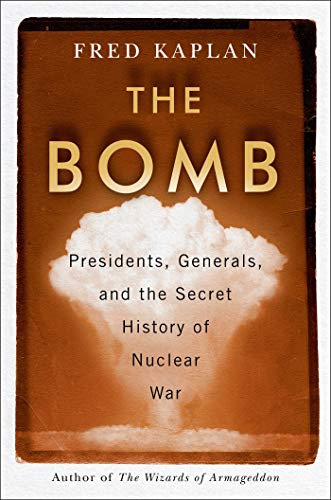
This book was a birthday present from site contributor Maddox von Ranke, our very own Dr Strangelove. I confess to having reservations about whether I would enjoy it: the intricacies of twentieth-century American nuclear bureaucracy, with its endless acronyms and committee meetings, didn’t inspire me. In some respects, my expectations were vindicated – there are an awful lot of acronyms and meetings. Yet, somehow, American journalist and author Fred Kaplan manages to marshal these into a story which is utterly gripping.
Bureaucratic politics
And so, like a scene in the movie Groundhog Day, yet another new administration rolled out yet another new set of documents, slogans, and acronyms in yet another stab at revising the nuclear war plan.
Fred Kaplan, The Bomb
Towards the end of the Cold War, Gil Klinger (who worked in the Department of Defence under Frank Miller, Director of Nuclear Targeting Policy)1 asked how many nuclear weapons were aimed at Moscow and the fifty-mile radius around it. The answer came back – 689. As might be expected, the blast radius of many of these bombs overlapped significantly – some targets were walking distance from one another. Apparently, nobody at Strategic Air Command (SAC) in Nebraska had the job of considering how many bombs were required to protect the United States. For decades they had simply accumulated ever more targets, and ever more nuclear weapons to hit those targets with.2
This is a story of how US nuclear strategy arrived at this point. But this isn’t just a story of American nuclear strategy. For me, it read like a fascinating case study in how bureaucratic machines run out of control, acquiring their own internal logic and momentum and becoming incredibly resistant to external constraints. Successive administrations attempted to get a grip on nuclear strategy and failed to do so. A bureaucratic machine originally created by General Curtis LeMay under President Eisenhower managed to trudge along regardless, to the point that even those working at the heart of SAC eventually didn’t understand the logic of their own war plans.
The original plan, formulated by people like Curtis LeMay, was to fire everything everywhere as quickly as possible. That plan was remarkably persistent and, in a disturbing way, had a sort of internal logic: since nuclear war is so difficult to control or de-escalate, you might as well throw everything you have at it whilst you can.
A pattern would repeat itself as each new president came into power. In simple terms it went something like this: the new president would be told about the Single Integrated Operational Plan (SIOP);3 they would be horrified;4 various brainy people would spend a few years looking at options for ‘limited’ nuclear war (i.e. why not start by firing a few bombs instead of all of them, in the hope that the Soviets could back off and nuclear Armageddon could be avoided?); the ideas would eventually be translated into policy papers and then official ‘policy’; SAC would completely ignore all this, except to the extent that plans for ‘limited’ nuclear war required new targets to be found and therefore more bombs; at the end of it all, SAC would end up with more bombs.
Russian roulette
Nuclear strategy has a disturbing internal logic. Essentially, it’s a game of bluff, in which the objective is to convince your opponent that you are crazy enough to launch nuclear weapons and thereby deter them from doing something you don’t want them to do. Usually, the thing you are trying to deter is a pre-emptive nuclear strike, but the US has never disavowed a first-strike option, and for much of the Cold War the United States took very seriously plans to launch a full nuclear strike against the Soviet Union and its allies in response to a conventional military attack on NATO.
Henry Kissinger wrote that nuclear strategy “is as much a psychological as a military problem” and that a “threat meant as a bluff but taken seriously is more useful for purposes of deterrence than a ‘genuine’ threat interpreted as a bluff”. In a confrontation, a “premium will be placed on irresponsibility, and both sides - Americans and Soviets - will “have to be ready to act like madmen’“.
There is, of course, a problem with thinking that your opponent is a madman. If you think your rival is trigger happy, then the idea of a pre-emptive strike becomes more attractive. And, furthermore, if you doubt your rival’s willingness to de-escalate, then there’s no value in the so-called ‘escalation ladder’ – you might as well throw everything you have at them as quickly as possible. So, whilst nuclear war gaming has an internal logic, it is also inherently destabilising. One US official likened it to Russian roulette: a ‘limited’ counterstrike was like playing with three of the six chambers loaded, while full retaliation was like putting a gun to your head with every chamber loaded.
The madman theory
It could be argued that the madman theory of international diplomacy is currently being tested to destruction, and it’s not working out very well.
In 2017, Donald Trump threatened North Korea with ‘fire and fury like the world has never seen’. Some months later, Senator Bob Corker, chairman of the Senate Foreign Relations Committee, convened a congressional hearing on nuclear command control. Senator Corker was a conservative Republican but nonetheless concerned about reports regarding the mental state of the new president. The question at the heart of the hearing was this: what constraints, if any, existed on the president’s power to launch nuclear weapons? General Robert Kehler responded that it was the president alone who decided, but that the military would not follow an order that was not legal. Not all the senators at the hearing found his response reassuring, given the complexities of determining what is or is not legal in this situation, and the difficulties in refusing a direct military order from the president.
We win!
“Why do you want us to restrain ourselves?” he screamed. “Why are you so concerned with saving their lives? The whole idea is to kill the bastards!” After a bit more of this tirade, Power said, “Look. At the end of the war, if there are two Americans and one Russian, we win!”
Fred Kaplan, The Bomb, recounting comments by General Thomas Power, SAC commander
There’s a dark humour throughout this book, which comes from the surreal quality of the discussions and decision-making, together with the personalities involved. Stanley Kubrick originally wanted to make a serious thriller about nuclear war but found the subject matter so bizarre that he ended up making a comedy, Dr Strangelove, and reading this book made me understand why. People such as the cigar-chomping General Curtis LeMay,5 who ended up running as the vice-presidential candidate alongside segregationist George Wallace in the 1968 presidential election, together with his protégé General Thomas Power, who even LeMay described as a ‘sadist’, come straight out of a Kubrickian parody.
Alien invasion
In some respects, Ronald Reagan could be seen as a Cold Warrior cut from a similar cloth as the plain talking 1950s and 1960s SAC commanders like LeMay and Power. But, in fact, no other president did more to achieve a rapprochement with the Soviet Union and secure reductions in nuclear arsenals. His ‘bad cop, good cop’ routine (tough on the Soviet Union in his first term; open to negotiation in his second) is credited by the author with achieving results which eluded all his predecessors.
His quixotic approach to international diplomacy often left his advisers and generals scratching their heads in confusion. At a meeting in Reykjavík with Mikhail Gorbachev, discussions were going nowhere until the two leaders, left alone with only their translators, agreed that each would come to the aid of the other if attacked by aliens. This was a theme close to the president’s heart: in a forthcoming speech at the United Nations General Assembly, Reagan wanted to expand on the power of an alien invasion to unite otherwise implacable foes, but his generals repeatedly removed references out of concern that they made the president sound unhinged. Eventually, the president got his way.
Was there anything I did not like?
It is worth noting that the subject matter of this book is quite narrow: this is a detailed retelling of American nuclear policy at the highest levels of politics and military command. Its focus is exclusively American, except to the extent that events and policies in other countries impacted on American strategy. It also has very little to say regarding how American public opinion or civil society interacted with American nuclear strategy. None of this is a criticism of the book, but a book with a broader or more comparative approach (for example, how did American strategy compare to Soviet strategy?) would also be of interest.
Conclusion
This book is a page-turner. It’s interesting on several levels: as an account of nuclear strategy, as a case study in bureaucratic politics, and as an exploration of game theory applied in real-world scenarios. I have no particular interest in military history, but I enjoyed this a lot.
Even those well informed about American politics in the 1980s might not have heard of Gil Klinger. But just before the end of the Cold War, he and his boss Frank Miller managed, through a combination of perseverance and focus, to get a grip on American nuclear strategy, something that eluded the likes of Robert McNamara and Henry Kissinger. Notwithstanding their efforts and the subsequent end of the Cold War, some of the incongruities of US military strategy continued: the administration of Barack Obama discovered that the US military had bombs targeted at empty fields (the rationale was that these had been identified as places Soviet planes could land after their airfields had already been destroyed by nuclear weapons). ↩︎
If all this makes the United States come across as the ‘bad guys’ in this story, it is worth noting that the only reason this book can be written is because America is, compared to the USSR and Russia, a relatively open society. The author notes in the Acknowledgements section of the book that much of the information in the book comes from Freedom of Information Act and Mandatory Declassification Reviews. Comparative information on Soviet nuclear strategy is not available. ↩︎
The United States’ plan for nuclear war. ↩︎
The post war American presidents (with one obvious exception) come out of this book well. Both Democratic and Republican presidents were serious minded people, keen to understand their responsibilities and options, and inclined to avoid mass death if possible. ↩︎
In meetings, LeMay would shove the cigar from one side of his mouth to the other, with the speed of such movements accelerating as he got more agitated. ↩︎
Book details
(back to top)- Title -
The Bomb : Presidents, Generals, and the Secret History of Nuclear War
- Author -
Fred Kaplan
- Publication date -
January 2020
- Publisher -
Simon & Schuster
- Pages -
384
- ISBN 13 -
978-1982107291
- Amazon UK -
- Amazon US -