Most human societies tend towards hierarchies: someone at the top giving orders, and everyone else at least pretending to follow the rules. And we tell each other stories to justify to ourselves why the rulers are in charge.
A popular story throughout history is that if your dad had the top job, that means you deserve it too. Often this idea is enhanced by the notion that the king is anointed by God (or at least his bishop). In the UK right now we all know that the prime minister is the most popular person in the country, according to a very complicated popularity contest.
Leaders in the Mayan world in central america had the clever idea that the reason they were in charge was because they were responsible for the integrity of space-time.
As “cosmic” actors, kings, queens, and other elites were charged with the essential role of... managing and curating the flow of time itself... Whereas farmers worked the fields, Maya rulers took on the responsibility of “growing” and sustaining the seasons that allowed agriculture to exist in the first place.
David Stuart, The Four Heavens
Nice work if you can get it!
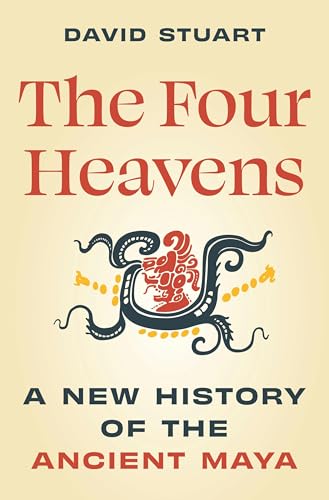
David Stuart puts names and sometimes faces to these kings and queens in The Four Heavens: A New History of the Ancient Maya, 'new' because it is only recently that we have been able to read the script that allows us to know and date these “time lords”, with Stuart himself being one of the key figures in this decipherment.
Where did they come from?
The Mayan people lived (and live) in south-western Mexico, Guatemala, and Belize. The foundational event that allowed them to live in ever bigger communities was the domestication of maize (sweetcorn) in around 1500 BCE. Amazingly it only took a few hundred years of maize eating - to about 1000 to 800 BCE - before people were banding together in sufficient numbers to build massive earthen plazas and pyramids. One huge site called Aguda Fenix is a rectangular platform an incredible 1,400 metres long by 400 metres wide, and has been estimated (so wikipedia reports) that it took 10-13 million person days of labour to build.1
From this point onwards there were various ups and downs, traceable in the construction and abandonment of pyramids, plazas and platforms, with a particularly notable downturn in 100-200 BCE when many of the Late Preclassic centres were left uninhabited.
The Four Heavens focuses on the period from 200 CE to about 800 CE - 'Classic Maya' civilisation.
What happened?
Despite the good progress made in deciphering the inscriptions we have on pyramids and whatnot, and while we can figure out the names and lifespans of a large number of kings and queens in the Classic Maya period, it is still quite hard to trace what happened over this 600 year period.
Part of the blame must go to the Spanish conquistadors, who as well as killing and enslaving lots of Mayan people also did their best to erase any records of their culture.
The most notorious example of this is Diego de Landa, a Franciscan Friar who visited various Mayan towns and settlements and asked if they had any good books to read. He would have a quick leaf through, ask a few questions about the incomprehensible characters and then - curiosity satisfied - set fire to them.
In his own words:
These people also make use of certain characters or letters, with which they wrote in their books their ancient matters and their sciences, and by these and by drawings and by certain signs in these drawings they understood their affairs and made others understand and taught them. We found a large number of these books in these characters and, as they contained nothing in which there was not to be seen superstition and lies of the devil, we burned them all, which they regretted to an amazing degree and which caused them great affliction.
Landa's Relación de la Cosas de Yucatán, translation by Tozzer, 169 2
A plethora of pyramids
What we do have though is the many awe inspiring ruins that were left behind such as Tikal, Uxmal and Chichen Itza. Through careful interpretion of the date and style of these ruins, plus the inscriptions and the odd pot, historians can make some educated guesses.
For example there is little doubt that there was a massive incursion into the Mayan lands in 378 by the forces of Teotihuacan, a place 1,300 kms away near to what is now Mexico City. Individual inscriptions even note that “Sihyajk'ahk' (a leader of the Teotihuacans) was here” with a precise date. This was such an important occasion that Mayan leaders were harking back to it as the good old days for hundreds of years afterwards, linking their own dynasties with the Mexicans.
So we can say exactly when this invasion arrived and trace its huge cultural impact in art and architecture. But we have no real idea beyond conjecture of why it happened, the motives are lost.
In their own words
Stuart's approach in The Four Heavens is to celebrate the evidence that we do have - remembering that only a few decades ago we had pretty much nothing.
He takes us through a variety of royal family trees from different areas of the Mayan world, describing how we know about each individual (for example: an inscribed stone from such and such a place), and how they interacted with each other.
Stuart also includes lots of pictures of Mayan reliefs and Mayan characters (glyphs) throughout the book, which are fascinating. I enjoyed the chance to ponder the images myself, to see what I could make of it all.3
Three forms of the Mayan glyph 'ajaw' or 'holy lord', copied carefully from the author
High politics only
One of the weaknesses of the book is the author's strict focus on high politics, with not really much to say beyond who ruled over whom and in what order.
We don't hear anything about the ordinary Mayan and what life might have been like for them. Neither do we get to hear about any of the more lurid (to us) aspects of the Maya life.
For example when visiting Yucatan a while ago I remember being struck by a number of stone reliefs showing Mayan rulers in “bloodletting” ceremonies: such as passing a thorny rope through their own tongues. As something outside of the range of my own experience I would like to hear more about this. But beyond one or two matter-of-fact references Stuart says nothing.
I suspect he suffers from professional archaeologist syndrome, a condition that I am familiar with from my Aunt who is also a professional archeologist. If I ask her to speculate about anything - even just for fun - she will usually reply that there is no evidence and so there is nothing to say. He may also want to avoid typecasting the Maya as alien others rather than relatable people.
Whatever the reason the book comes across as a sober record of Mayan inscriptions, their translations and what we can say about them, rather than a story of the Maya per se - I had no feeling of empathy for any of the Mayans I met in the book.
Where did they go?
Of course the one big event that it is impossible to avoid speculating about is what happened to them? Or more specifically why did the Maya abandon their towns, often homes to tens of thousands of people, the product of millions of man hours of labour?
Here Stuart does share some thoughts, pointing to factors such as: a general drying up, increased warfare (even before the rains failed), or just deciding it is time for a change and moving on.
Interestingly he doesn't refer to deforestation and soil erosion as a cause, so maybe this idea has been rejected now.
The two things that struck me were:
-
When your environment dries out, you are in trouble whatever else is going on. If you don't have a surplus of food to support the elites and their fancy urban lifestyles, that way of life is going to change. Disruption, suffering and conflict would surely result, whether the situation was good or not beforehand.
-
The Mayan aristocracy (and people in general) seemed to be quite mobile with dynasties able to move from place to place while preserving their authority. This means that a dynasty would be more likely to move on rather than grimly cling to their ancestor tombs and ball courts, whatever the cost.
The show goes on
The other key point is that while the heartlands of the Maya saw their plazas and palaces fall empty, the Yucatan and the north saw growth and revival. Cities like Uxmal and Chichen Itza, which so many tourists flock to now, were actually constructed after the collapse and lasted a few hundred years more. Longer than most modern day cities have existed in either North or South America to date.
What I liked most about the book
The best thing about this book in my view is that it is possible to write it at all.
The fact that we can now piece together a chronicle of the Maya in something like their own words is remarkable, when just a few decades ago we understood almost none of this.
Conclusion
An overview of the history of the Mayan people, from the earliest records to their ultimate conquest by the Spanish, this brings us right up to date with the latest thinking and discoveries.
The dense overlapping record of kings, queens and their dynasties can be dry at times, but the flipside is that you get a factual no-nonsense account that puts the Mayan people at the heart of their story - back in control of their time.
Review by Noble Lord Webb
As a size comparison, this area is equivalent to 56 of London's Trafalgar Squares, lined up in a 4 by 14 rectangle. This wasn't a town because there is no evidence of people living here, but must have been some sort of massive community centre. ↩︎
The translation doesn't exaggerate, it really is that bad. In de Landa's own words: “Usaba también esta gente de ciertos caracteres o letras con las cuales escribían en sus libros sus cosas antiguas y sus ciencias, y con estas figuras y algunas señales de las mismas, entendían sus cosas y las daban a entender y enseñaban. Llallámosles gran número de libros de estas sus letras, y porque no tenían cosa en que no hubiese superstición y falsedades del demonio, se los quemamos todos, lo cual sintieron a maravilla y les dio mucha pena.” Relación de las Cosas de Yucatán, sacada de lo escribió el padre fray Diego de Landa, XLI siglo de los maya - escritura de ellos ↩︎
The pictures were often confusing for me - it made me realise that we read pictures as well as reading words, and if you have no knowledge of a culture, understanding even a simple image is often challenging or even impossible. ↩︎
Book details
(back to top)- Title -
The Four Heavens : A New History of the Ancient Maya
- Author -
David Stuart
- Publication date -
April 2026
- Publisher -
Princeton University Press
- Pages -
480
- ISBN 13 -
9780691213842
- Podcast episode -
Matt and Shane‘s Secret Podcast: Ep 616 - The Four Heavens (feat. David Stuart)
- Amazon UK -
- Amazon US -